
HR data consolidation after acquisition is a hard problem when six companies are involved. Ellsworth Corporation, a chemicals manufacturer and industrial distributor, formed from six separate companies, was consolidated under one FEIN. Years of growth through acquisition left duplicate employee numbers in the system from earlier deals. Ellsworth hadn’t resolved these duplicates when it began planning its move from UKG to Workday. ResNav’s platform preserved 2,100 employee records and roughly 10,000 payroll and tax documents from that legacy environment. It also resolved more than 100 duplicate employee records in the process.
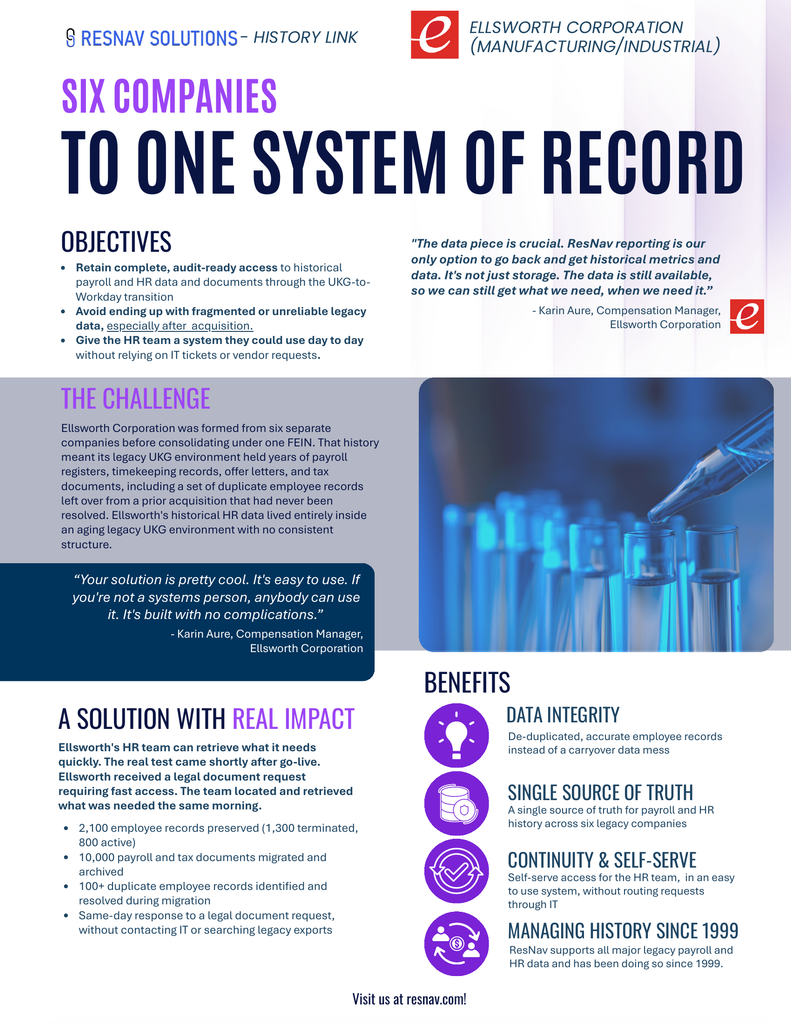
The Challenge: Six Companies, One Messy HR History
Six companies became one organization at Ellsworth. The underlying HR data was never fully reconciled to match. Each company brought its own payroll registers, timekeeping records, offer letters, and tax filings into the same UKG environment. No consistent structure tied them together. One prior acquisition in particular left a set of duplicate employee records that split individual work histories across more than one employee number, a problem that sat unresolved for years.
Nobody could tell at a glance which employee number reflected someone’s real, continuous work history. Payroll history for a single person sometimes lived across two separate records from the earlier acquisition. That fragmentation makes an audit request harder to answer than it should be.
Ellsworth’s move to Workday put a firm expiration date on UKG access. Whatever wasn’t extracted and organized before that cutoff risked becoming unreachable. Compensation Manager, Karin Aure, and her team needed two things at once. They needed a full, accurate record of roughly 2,100 employees’ payroll and status history. And they needed a fix for the duplicate-record problem that had been accumulating since the earlier acquisition.
The Solution: How ResNav Consolidated Ellsworth’s HR Data After Acquisition
ResNav ran the Ellsworth engagement through its standard four-phase process. That process covers kickoff and data access setup, extraction, processing and conversion, and go-live with training and support. The extraction phase pulled the full legacy dataset. That included roughly 10,000 individual payroll and tax documents, such as W-2s, W-4s, and state tax forms.
Kickoff covered data access setup and mapping, so ResNav knew which systems held what before extraction started. Six companies meant six sets of historical conventions layered into one UKG environment.
The deduplication work happened during processing. ResNav traced the more than 100 duplicate employee records back to their source acquisition. The team rebuilt single, accurate histories for each affected employee before finalizing anything in the archive. Once ResNav structured the data, Ellsworth’s team could query and report against it directly instead of treating it as a static export. When Ellsworth found a gap in what the initial platform access covered, ResNav built the missing piece. It didn’t leave that gap as a workaround.
“Your solution is pretty cool. It’s easy to use. If you’re not a systems person, anybody can use it. It’s built with no complications.” – Karin Aure, Compensation Manager, Ellsworth Corporation
The Results: What Changed for Ellsworth’s HR Team
ResNav preserved 2,100 employee records, split between 1,300 terminated and 800 active employees, along with about 10,000 archived payroll and tax documents. ResNav identified and resolved more than 100 duplicate employee records instead of carrying them forward into the new system.
The clearest proof came soon after go-live, when Ellsworth received a legal document request for historical payroll records. Rather than searching old exports or opening an IT ticket, the team pulled what it needed and answered the request that same morning.
“The data piece is crucial. ResNav reporting is our only option to go back and get historical metrics and data. It’s not just storage. The data is still available, so we can still get what we need, when we need it.” – Karin Aure, Compensation Manager, Ellsworth Corporation
What This Case Study Shows About HR Data Consolidation After Acquisition
HR data consolidation after acquisition surfaces problems that predate a company’s current HR platform. Ellsworth’s experience points to a few takeaways for HR and compensation teams handling their own consolidation.
- A platform migration is often the forcing function for fixing old data problems. The duplicate records at Ellsworth existed long before the Workday move. The UKG cutoff is what made resolving them urgent.
- Deduplication has to happen before data lands in a permanent archive. Migrating duplicate or fragmented records as-is just moves the problem instead of solving it.
- Self-serve access matters more after go-live than during it. The real value showed up weeks later. HR could answer a legal request the same day instead of routing it through IT.
- Experience with legacy payroll platforms shortens the timeline. ResNav has worked with major legacy HR and payroll systems since 1999. That history is part of why a dataset this size stayed on schedule.
Facing a Similar Data Cleanup Ahead of a Migration?
If your organization has grown through acquisition and is heading toward a platform change, it’s time to talk through what a clean migration of your historical payroll data and documents could look like.
Don’t let data migration and compliance issues hold you back. Let’s connect to discuss how ResNav supports HR data consolidation after acquisition, from payroll history to compliance documents.
Frequently Asked Questions
For Ellsworth, it meant preserving 2,100 employee records (1,300 terminated, 800 active) and roughly 10,000 payroll and tax documents using ResNav History Link.
Ellsworth consolidated six companies under one FEIN over time. One earlier acquisition left duplicate employee numbers in the system that split individual work histories across multiple records, and this had never been corrected before the Workday migration.
ResNav identified the source of the duplicates during data processing and rebuilt accurate, single-employee histories for each affected record before finalizing the archive, resolving more than 100 duplicate records in total.
Yes. Ellsworth’s HR team can retrieve pay stubs, payroll registers, and other historical documents directly, including a same-day turnaround on a legal document request shortly after go-live.